Simon Rodia’s Dream
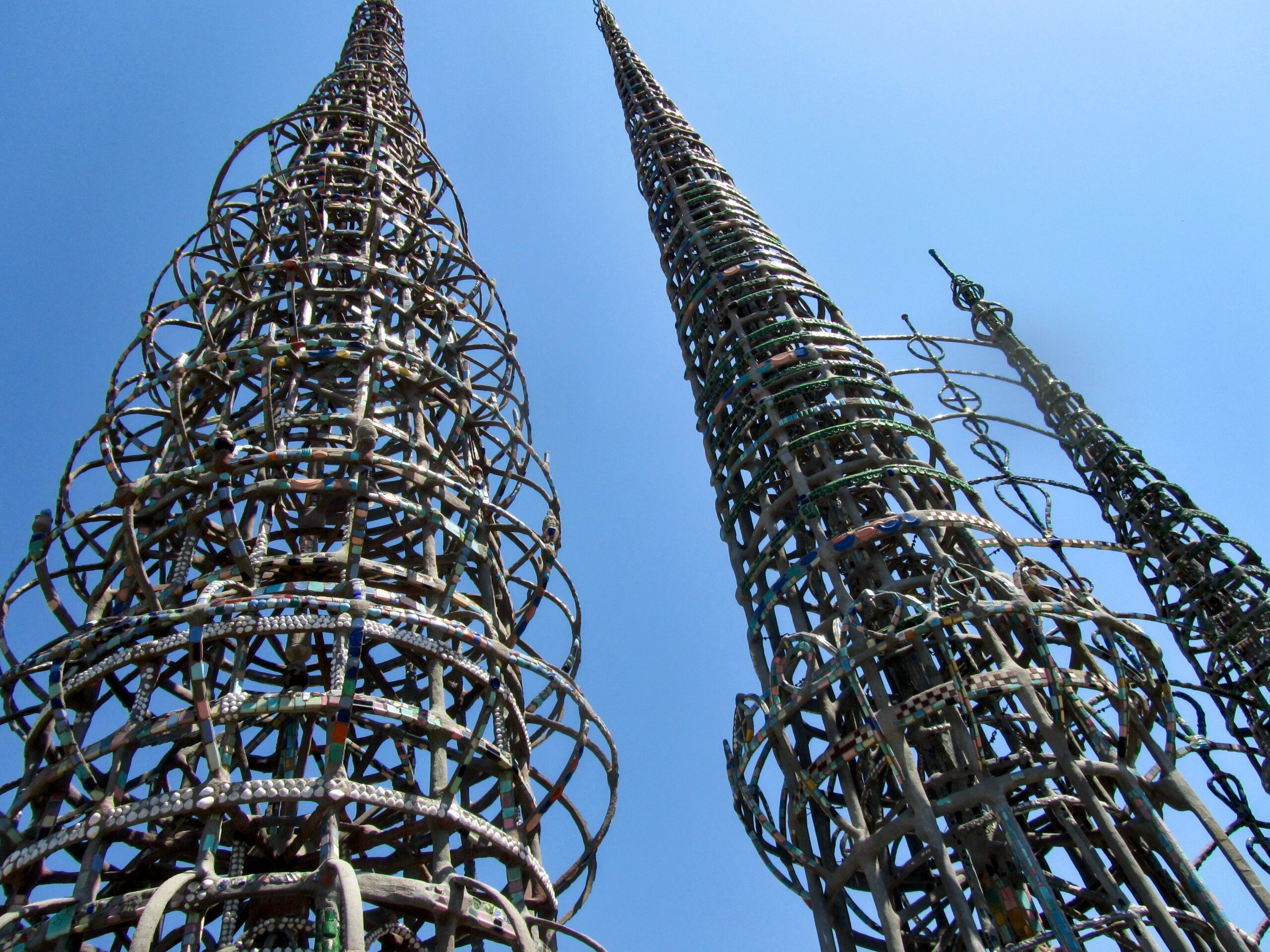
The Simon Rodia’s Dream, the virtual geocache found at the Watt’s Towers, does not describe the dream other than to quote Rodia: “I had in my mind to do something big and I did.” That may be the best way to describes his accomplishment in creating the world’s largest single construction made by one person. It has been called “outsider art,” something self taught, created outside the boundaries of official culture
The facts about Simon Rodia and his art have been well documented. Anyone can read about how the towers were built or how tall they are. The greater mystery is with Rodia himself.
 I disagree with the cache when it states the towers were a tribute to Rodia’s adopted land. I have read that, and can only find it as a secondary source rather than a direct quote. That answer is too simple. Ultimately, the reason for building the towers has to be found elsewhere.
He called his work ‘Nuestra Pueblo,” our town. That name speaks of a cherished place or a shared experience. It belongs to no one person. It brings to mind something closer to the realm of spirit than a tribute to a nation.
Rodia worked alone. As an outsider his art was dismissed by some who watched him build the towers. But he was compelled to continue, to create something big without any formal plan. An inner voice guided him about what to do next, or whether something needed to be redone. And then it was finished.
It may be that Rodia was no longer capable of working on the Towers after he suffered a stroke. However, many who undertake a life long creative project never finish. Rodia did. That alone makes me wonder what made his vision successful.
My Log
 The Watts Towers are a testament to compulsion, drive, vision, dreams, hard work, even more compulsion — things that go beyond every day experience. It took more than a dream for Rodia to create this site. He started work in 1921. He worked during every spare moment for 34 years, without benefit of machine equipment, scaffolding, bolts, rivets, or welds. For some reason his wife thought he was obsessed and soon left him.
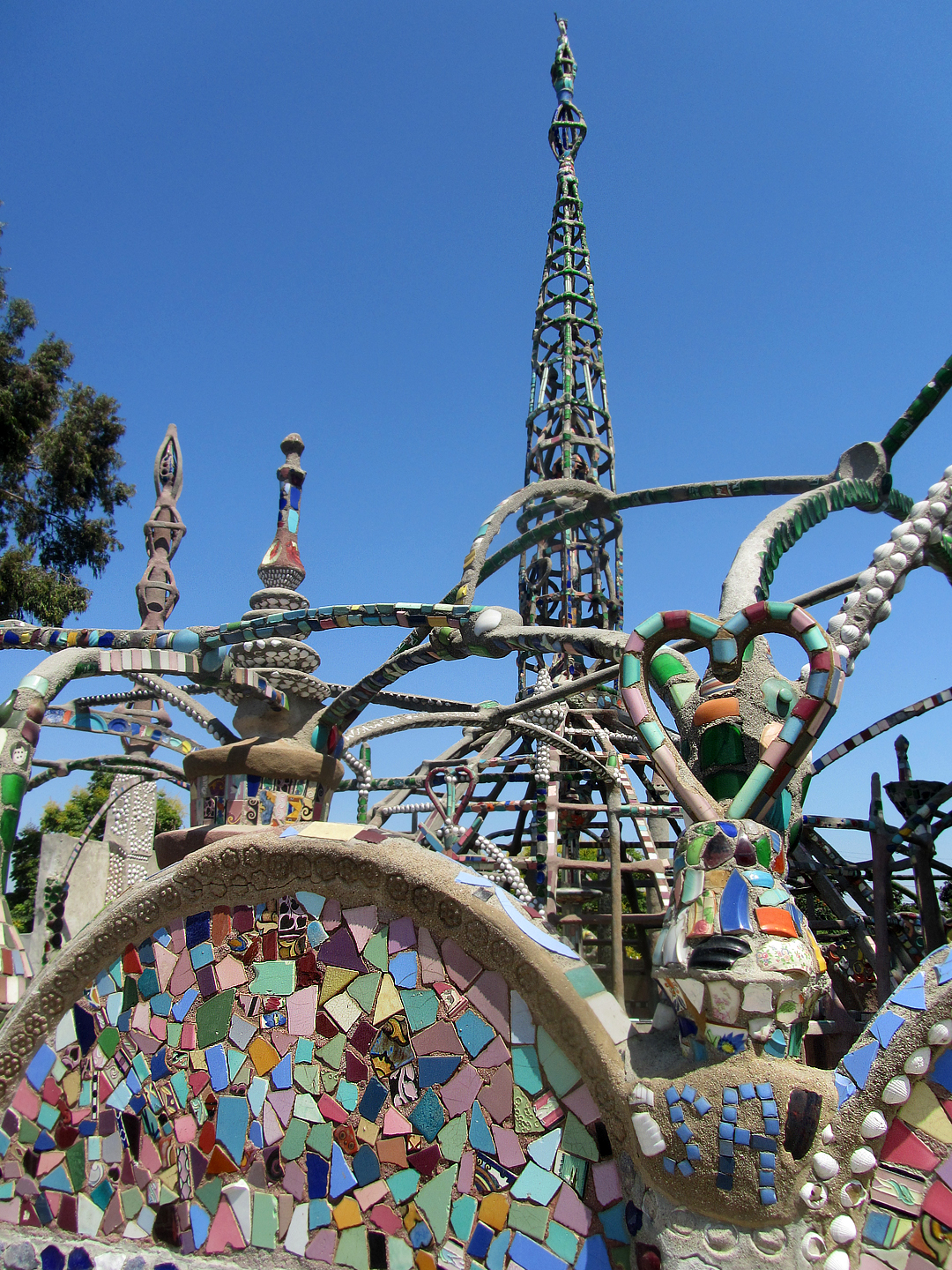
His work continued. He bent every rebar, set every tile as part of the mosaic. He gathered the materials from wherever he could find them and worked without a permit.
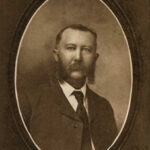
Rodia suffered a stroke in 1954, and a fall from one of the towers not long after. He announced that his work was done. He left the keys, gave the property to a neighbor, and moved far away, never returning.
When you are done, you are done
Somehow the towers survived the effects of time and threats from bureaucracy, which once ordered them to be removed. When the area erupted in a riot, the towers were left untouched. Here they stand, a handful of dreams that Rodia planted and left for others to harvest.
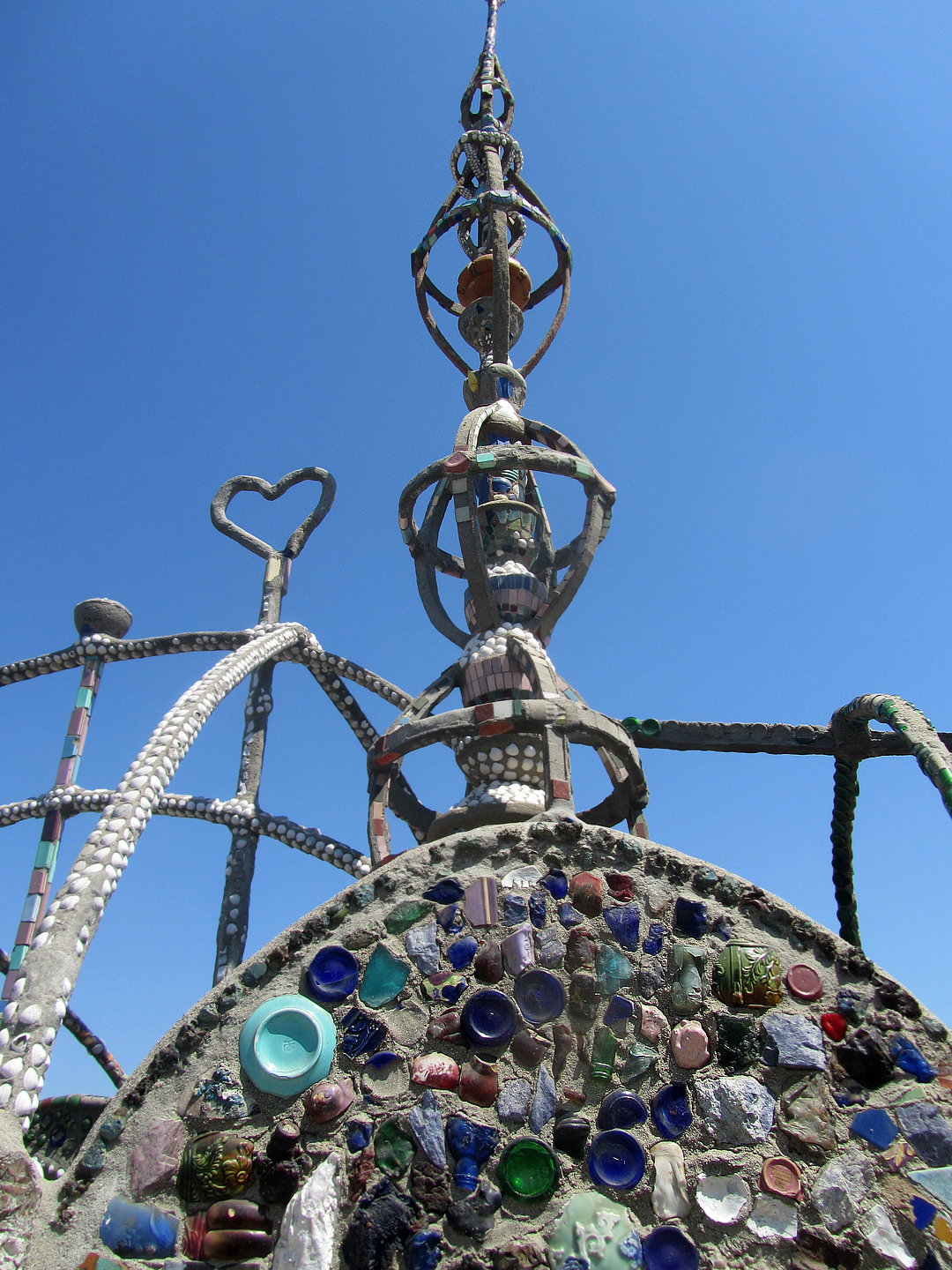
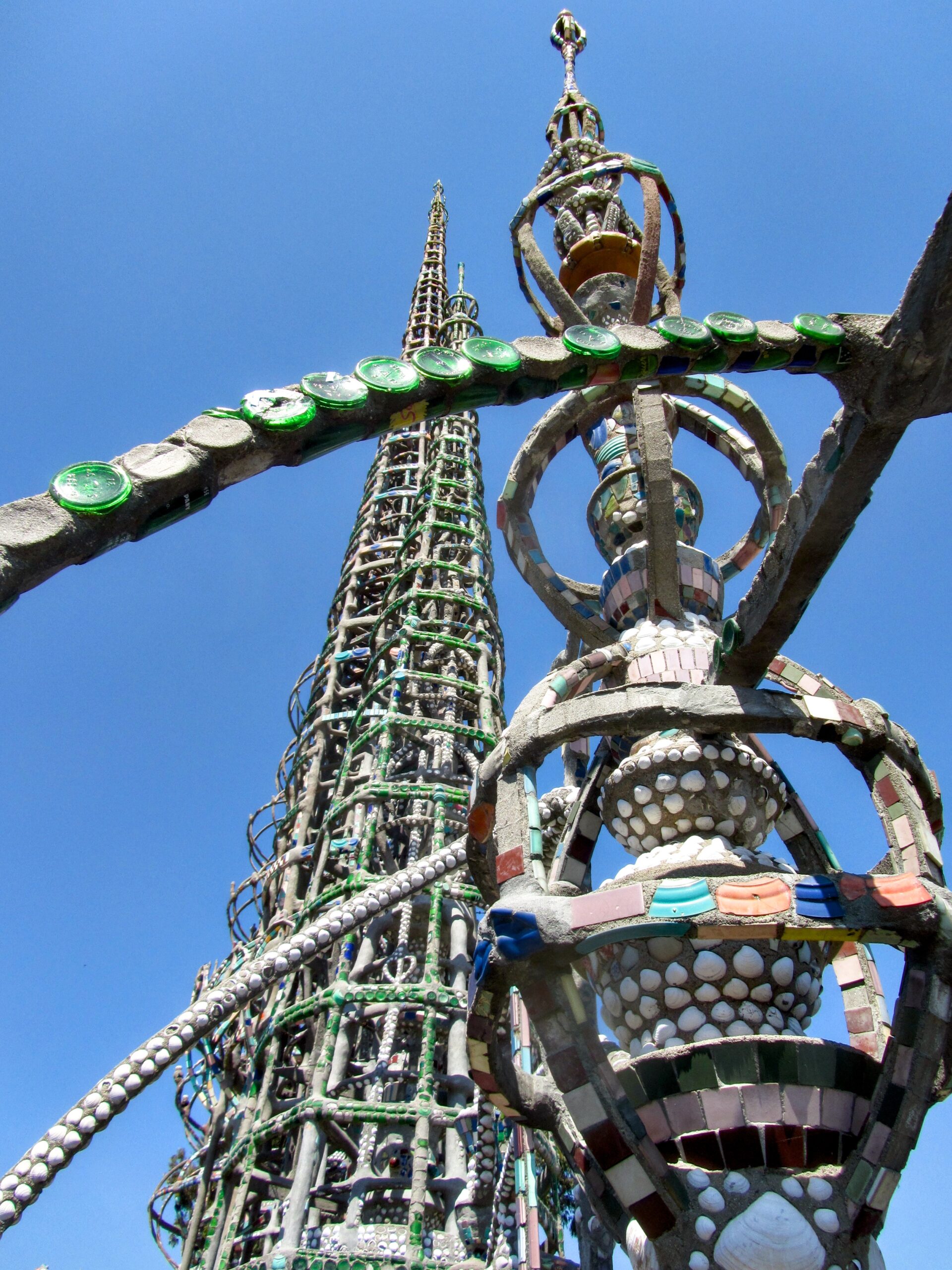
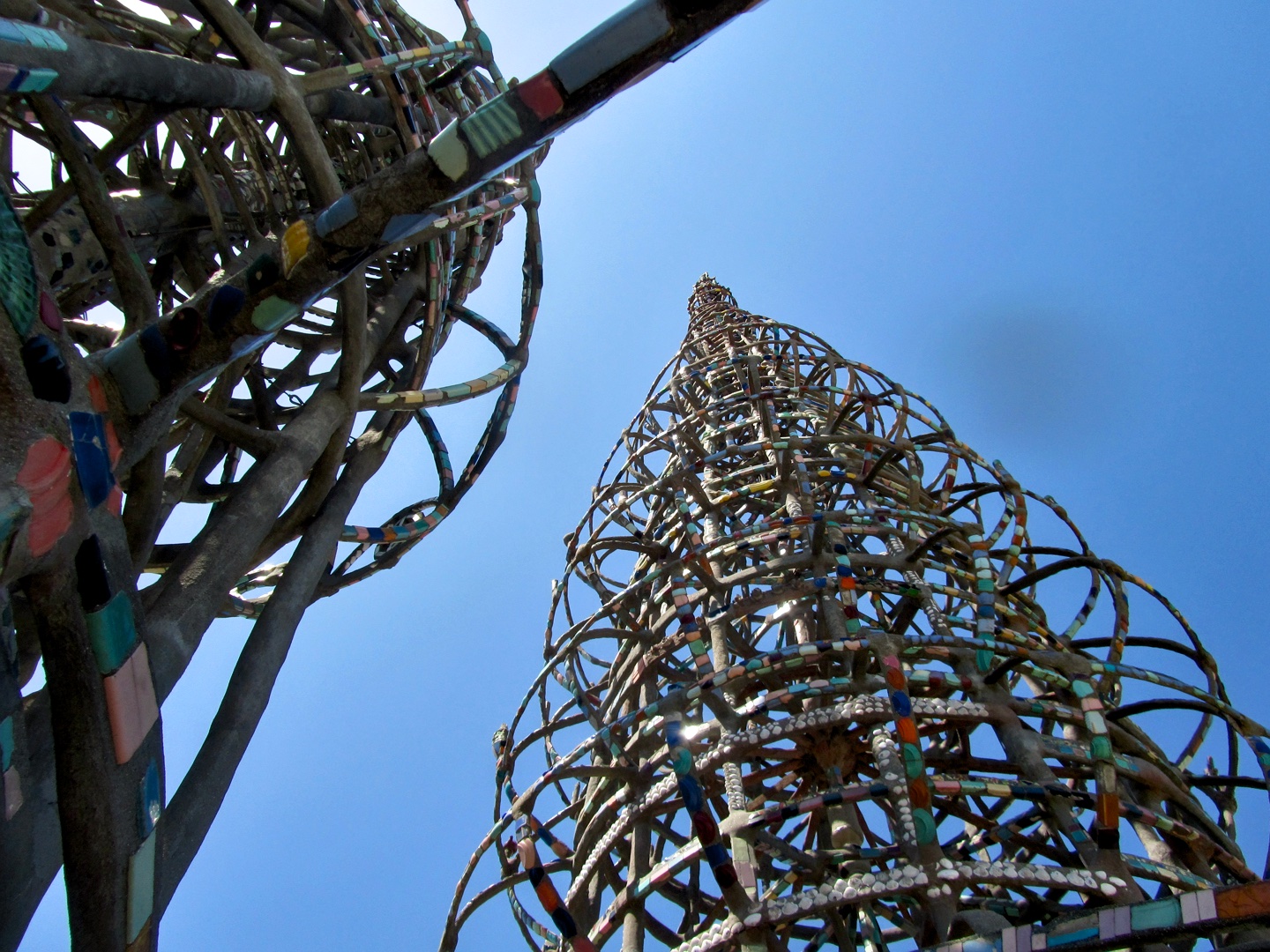
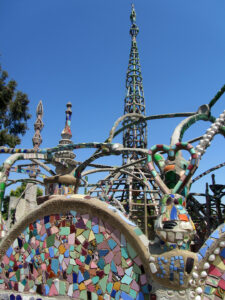
The Watts Towers don’t dominate the skyline so much as pierce it, thin needles threaded with shards of color. They look at once accidental and inevitable, as if they grew by their own eccentric will. To the metal, Rodia added broken tiles, old soda bottles, scrap, and seashells. He took the residue of life and created something new. He reached for the sky.
I don’t know if Rodia was touched by genius or under a compulsion that had to be met. Perhaps both. It reminded me of the story of the Fisher King, who was wounded and could only find a measure of relief through fishing, at least until Parsifal (Perceval) asked, “For whom does the grail serve?”
I suspect Rodia had a similar wound, but it was not fishing that provided him relief. He turned to the Towers and worked on them until they were finished. How could someone not be transformed by that process? It is the hero’s quest. But whatever Rodia discovered about himself, he seems to have kept it to himself.
Anyone who visits might find their own answer. The question is all important. For whom does the Tower serve?
Postscript: Transcendence
 When Parsifal asked his question, the Fisher King and all of the domain was healed. The King no longer had to fish. When Simon Rodia finished the Watts Towers, he did something almost as mythic: he walked away, gave the property to a neighbor, and never returned.
There was no ceremony or explanation. He made no attempt to preserve or control the work. He just left. It was up to others to decide whether to preserve it. It came within a hair’s breadth of being destroyed.
The Fisher King’s wound bound him to an endless task. Rodia’s “wound” — whatever it was that drove his vision — bound him to build the Towers for 34 years. Like the Fisher King, he faced a daily task. It wasn’t a hobby or a job, it was a ritual.
When Parsifal asked his question, the Fisher King was released from his compulsion. Rodia similarly reached a moment where the task completed himself, as much as he completed the task. The Towers were done, his inner necessity no longer compelled him. He did not need Parsifal. What was he to do but to move to Martinez?
He had reached a point of transcendence. He succeeded in a quest that had consumed his life and walked into something very different. He left it to the world to decide what the Towers meant. My best guess is that they mean Nuestra Pueblo..
 “I love you my town, you’ll always live in my soul.” — Iris Dement