The Granite Manifesto
— John Samuelson’s Desert Creed

Joshua Tree inspires oracles. Perhaps it stems from the desert prophets who found their voice in the wilderness. However, it could also be the effect of desert mining or spending time alone in the dry heat. Some will find wisdom, others will become mad. A few might be both. John Samuelson was a person who stretched the boundaries at both ends.[1]This section does not refer to the Desert Oracle, a fine podcast, radio show, and publication that will enrich your understanding of the area around Joshua Tree.
Samuelson was born in Sweden. After immigrating to the United States, he worked various jobs as a miner, carpenter, and oil-field laborer before making his way to the desert around 1926.
Almost from the start, he created his own myth and legend. He sold his “life story” to Earle Stanley Gardner, alleging that he had been shipwrecked off the coast of Africa. He was held captive by a tribe that spoke to monkeys. He found a golden treasure that was guarded by intelligent killer ants. Although a chief’s daughter had fallen in love with him, he found himself in trouble with the tribe’s elders. The tribe forced him to eat the “bread of forgetting” that almost wiped his memory and caused him to come down with sleeping sickness whenever it rained.
 Samuelson worked for the legendary miner and rancher, Bill Keys, before striking out on his own to establish a homestead and mining operation with his wife. The granite hills and sparse vegetation of the high desert inspired him.
Over a period of several years, he carefully chiseled large inscriptions into seven major boulders, creating eight separate panels. The carvings addressed subjects ranging from religion and evolution to politics, economics, morality, and human nature. Spelling was not his strength, but his message was not dependent on the normal rules. (See the inscriptions here.)
In a sense, I thought about what would have happened if the creator of the Georgia Guideposts had ended up as a desert rat.
THE ROCK.
OF FAIHT.
AND TRUHT.
NATURE. IS. GOD.
THE. KEY. TO. LIFE.
IS. CONTACT.
EVOLUTION. IS. THE MOTHER
AND FATHER OF MANKIND.
WITHOUT THEM. WE. BE. NOTHING.
JOHN SAMUELSON.
1927.
Samuelson’s homestead application failed in 1929 because he had not completed the process of becoming an American citizen. This setback devastated him. He continued mining and prospecting, invented a rotary drill-bit improvement that received a patent, and pursued a variety of ventures, but success eluded him
In 1942, he became involved in a fatal altercation in Los Angeles that left one man dead and another wounded. After his arrest, questions about his mental health emerged, and he was eventually confined to a California state hospital. He eventually escaped.
Bill Keys received a letter from Samuelson many years later, in 1954, stating that he wanted to return to the desert but was afraid of being caught and sent to prison. Some time later, Keys received a letter from the officials at the logging camp where Samuelson was working. He had apparently been seriously injured in a logging accident. Another letter soon followed, informing Keys that Samuelson had died as a result of his injuries.
The virtual geocache at the rocks urges people to Think About It. Perhaps that is all Samuelson could ask of anyone.
My Log
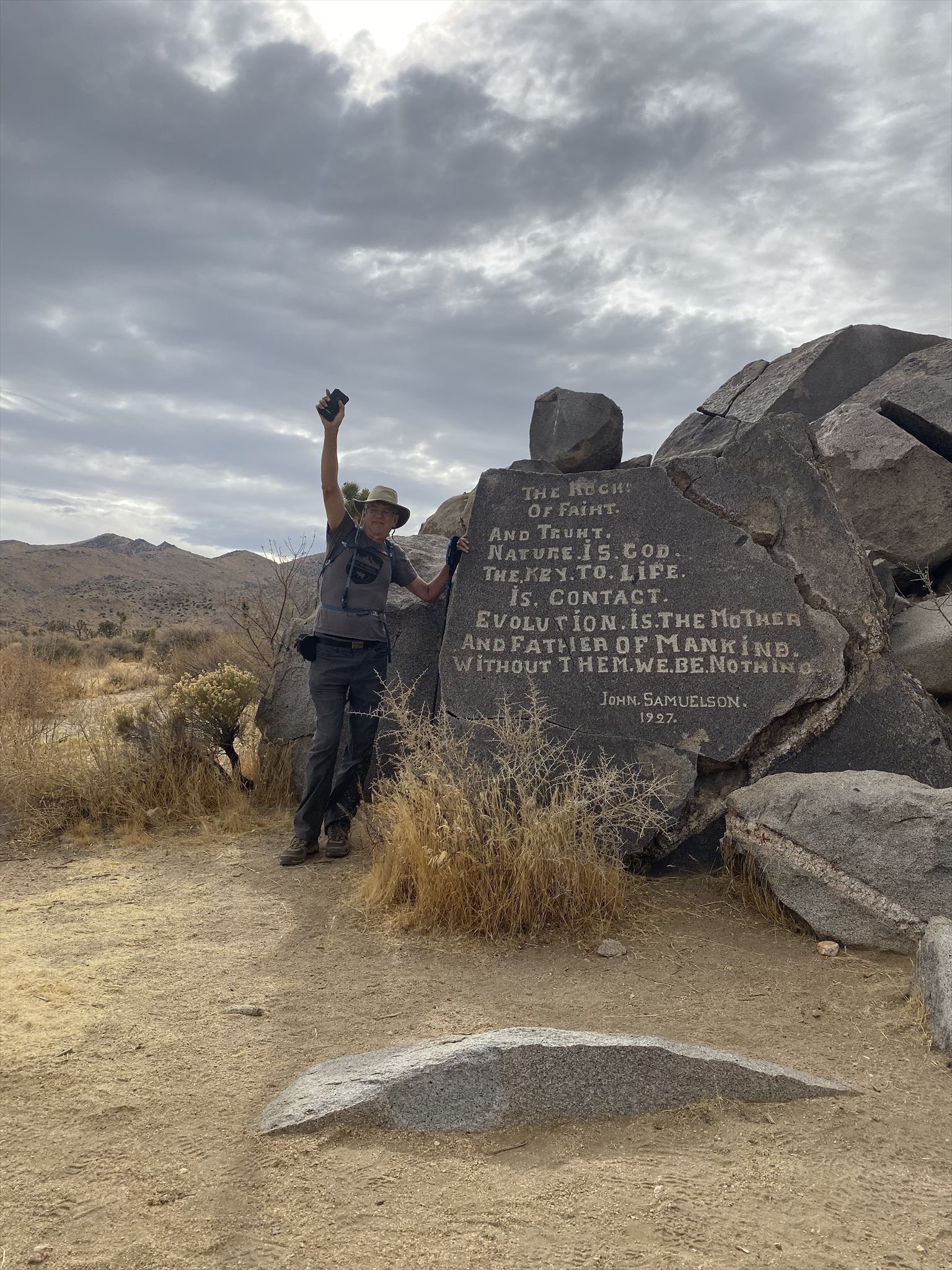 At what point does writing on rocks constitute more than graffiti? Is it a matter of history or something else? Last summer, a Native American elder told us that petroglyphs were reserved for those who had the gift. Not everyone could do it. I don’t know if Mr. Samuelson had the gift, but he did more than write his initials. He offers a different type of guidepost, and something is intriguing about it. We pondered over what we read, both to decipher some of the spelling and to unravel his meaning.
There are some of his words that seem relevant today. We have seen bank bailouts and ever-increasing wealth inequality. Samuelson asks Mellon where the money went. He asks Hoover why the milk of human happiness doesn’t have thick cream on it for all. And he echoed the Wobblies when he urged people to find heaven in this life and called for the tax and bond slaves to wake up, asking why are politicians the friend of bankers and big business? Good questions.
I understood him when he wrote that with time, the ocean can grind the hardest granite into powdered sand. But I am not sure I agree that ‘the human race will grind out its own destiny regardless of the opposition and party in power.
Perhaps Samuelson was influenced by the solitude of a desert homestead, but it has become clearer that we must come together to save the wild, the places we love, and the planet. Water will indeed wear the rock away, but the destiny of human beings — if humanity will have a destiny — is not separate from opposition. It requires the type of resistance that will eventually wear down power and allow the human race to create something new.
Samuelson ultimately reminded us to study nature and obey its laws. Undoubtedly, Joshua Tree was a good place for him to study. Certainly, others, from hermits in the desert to the modern calls to preserve the wild, have found their meaning in such places. We learned a lot from the rocks, the Joshua Trees, the harshness and beauty surrounding us.[2]Ed Abbey’s Desert Solitaire and Amy Irvine’s Desert Cabal are both good places to start.

11/19/2019

Notes
| ↑1 | This section does not refer to the Desert Oracle, a fine podcast, radio show, and publication that will enrich your understanding of the area around Joshua Tree. |
|---|---|
| ↑2 | Ed Abbey’s Desert Solitaire and Amy Irvine’s Desert Cabal are both good places to start. |